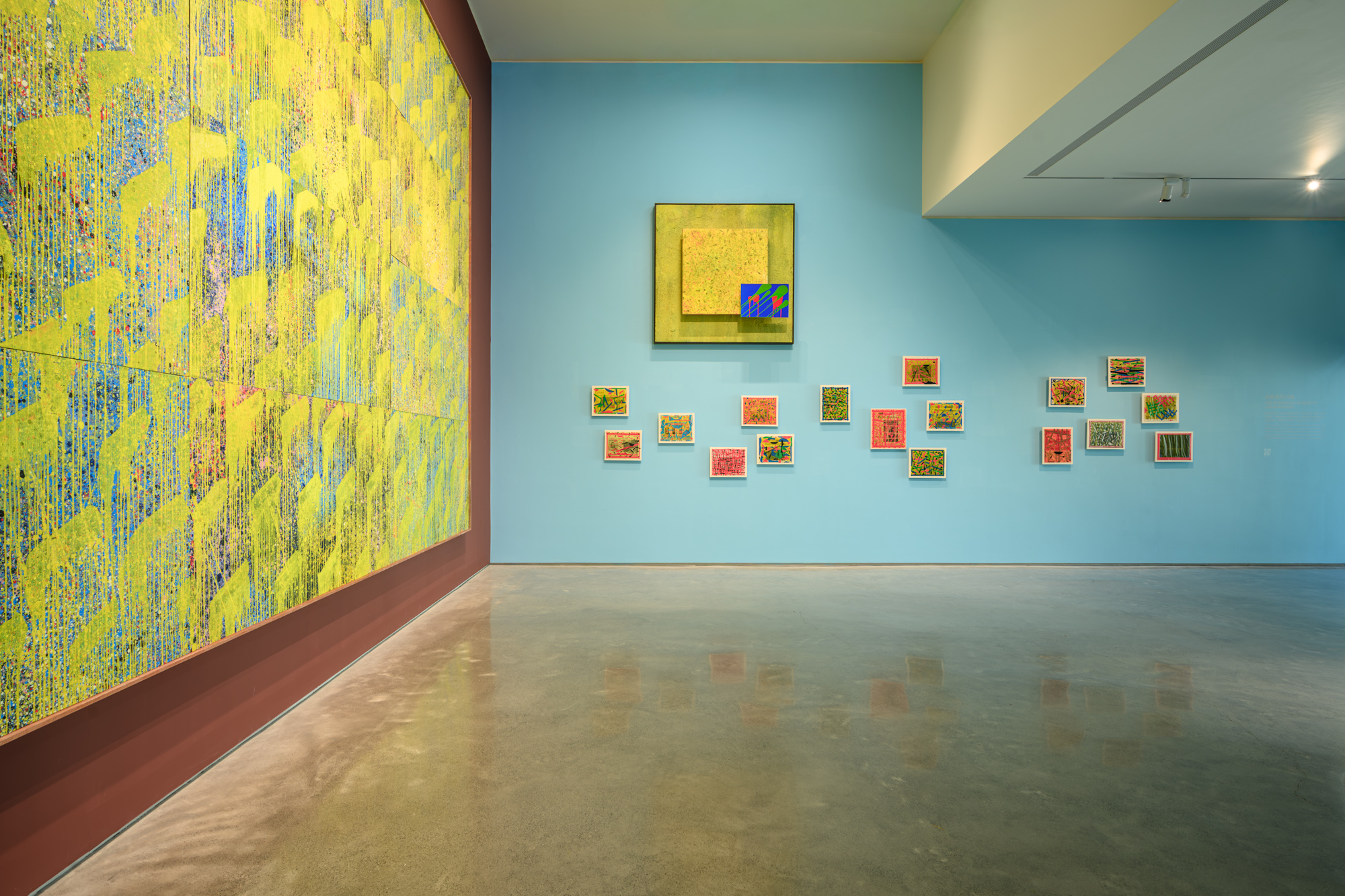
>>Download press release text and images (Images updated 12/16/2025)|Kindly review the copyright notice before use. When using images, please follow the credit indicated in the file name: either "© Paul Chiang Art & Culture Foundation" or "Photo courtesy of Paul Chiang Art & Culture Foundation / Photography: Studio Millspace. All rights reserved."
How many “firsts” are still possible at age 84?
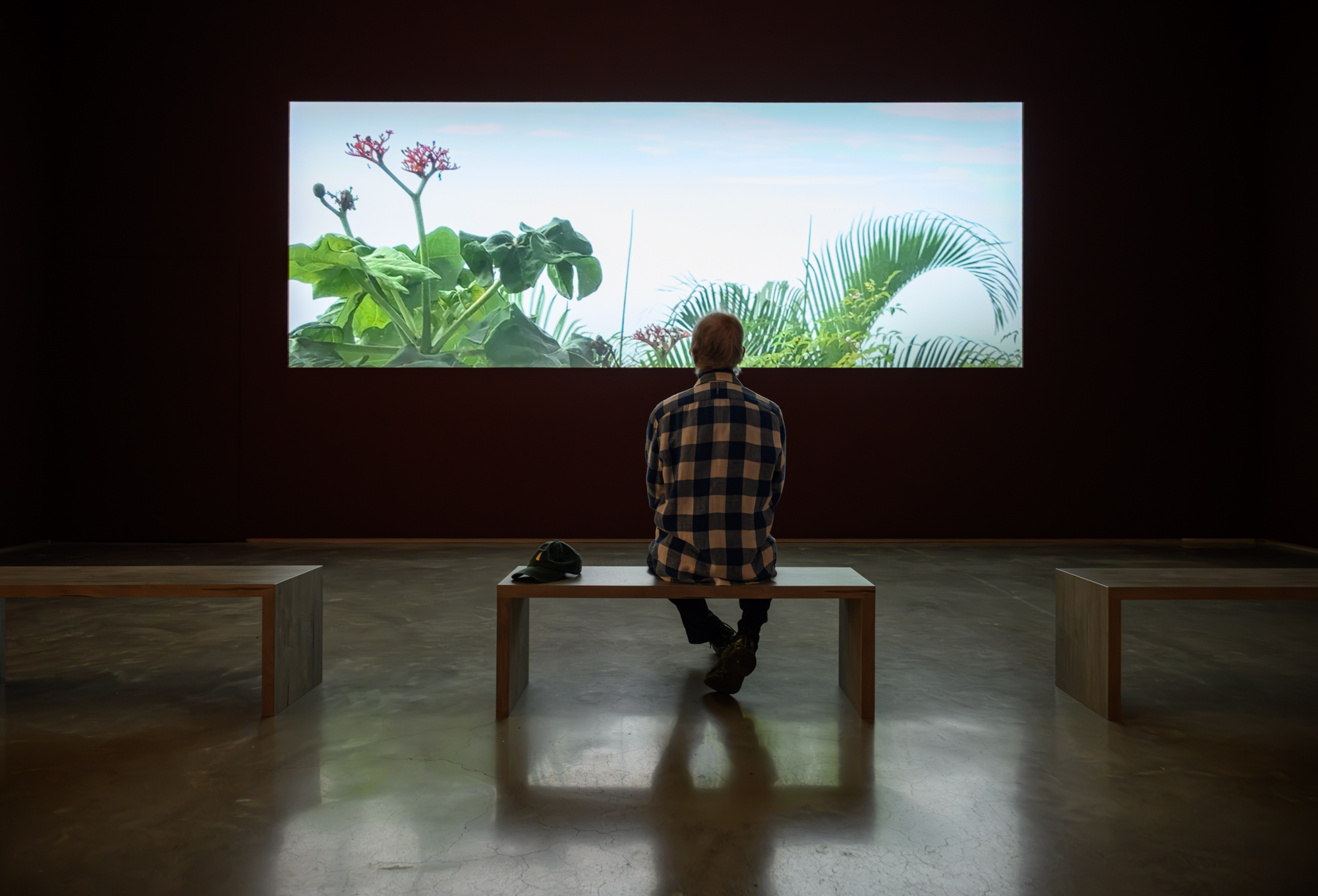
After a sudden serious illness this spring and summer, abstract artist Paul Chiang created the “Window”, his first video work—and what he calls “the most realistic” work of his life.
On September 18, the Paul Chiang Art Center opened its new exhibition, Beyond the Canvas: Matter and Spirit in the Art of Paul Chiang. From playful experiments with everyday materials to a lifelong search for spirituality, the exhibition moves across canvas, construction formwork panels, The New York Times, masking tape, walls, video, sculpture, and space. Yet throughout, Chiang returns to the same enduring concern: beauty and goodness in human nature.
The exhibition was developed by Chiang together with the curatorial team of the Paul Chiang Arts and Cultural Foundation. The artist was closely involved in selecting works, shaping the galleries, and developing the narrative.
Its two key visuals reflect this dialogue. One draws from a 2001 Self-Portrait, one of only two self-portraits Chiang has made. The other comes from the “Window”, created after his illness. One looks inward; the other looks outward at the world anew.
The title Beyond the Canvas was chosen before Chiang became ill. After this turning point, it took on another meaning: not only his decades-long exploration beyond conventional materials and forms, but also a deeper reflection on art and life.
A Window, Rediscovering the Everyday
While confined to bed, the window became Chiang’s most important connection to the outside world.
Coral plants, morning glories, yellow palms, elephant ears, sunrise and sunset, heavy rain, insect calls, and butterflies suddenly appeared different to him.
“Things I had seen daily took on new meanings. That made me want to record them and create a project from stillness to motion work.”
On many nights alone, he watched leaves bend nearly to the ground in the wind, then rise again after the rain. Fragility and resilience played out repeatedly outside his window. Time could feel unbearably heavy, yet a beam of light, a flower, or a butterfly could suddenly make it feel weightless and transparent.
Without the physical limitations that forced him to put down his brushes and paint, the “Window” might never have existed. This work recorded nature and Chiang’s experience of illness, while also expressing his gratitude to his wife, who has accompanied him throughout his life.
A Wall: Learning to Value Empty Space and Imperfection
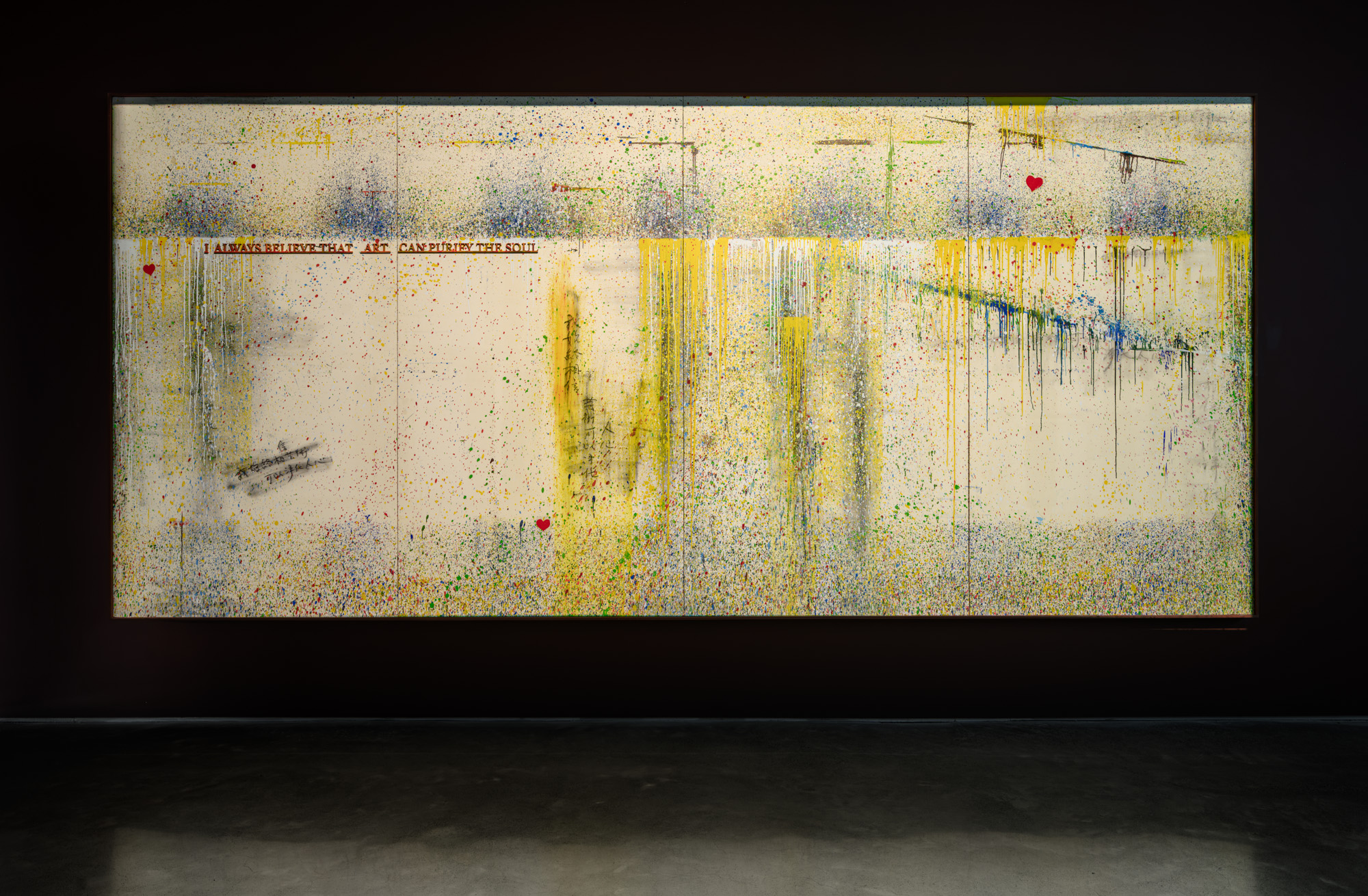
Chiang also cut away a section of his studio wall and turned it into art.
Countless works had been made in front of it, leaving decades of paint splashes and color tests. He had rarely paid attention to the wall before. After his illness, he saw it differently.
“It felt completely natural, without pretense. For the first time, I realized that all those little marks on the wall were extraordinarily beautiful.”
Chance, empty space, and imperfection became new ways of seeing. Chiang named the series after a belief he has held for decades: “art can purify the soul.”
Another wall became the canvas itself. Using masking tape directly on a gallery wall, Chiang created Beyond the Canvas, a work sharing the exhibition’s title. Lines have long been central to his abstract language, but masking tape offered something new after his illness: it required little physical effort and was immediate, direct, simple, and strong. He calls it an unexpected “treasure.”
Sixty Years of Morning Reading Becomes Art
Chiang spent 30 of his first 60 years living and working in New York. After returning to Taiwan, The New York Times remained one of his ways of staying connected to the world.
His new mixed-media collages on old newspaper pages emerged as another creative response to physical limitations. Over more than a century, The New York Times has developed a disciplined visual structure—from its masthead and columns to headlines and photographs. Chiang cuts apart and rearranges that structure, intervening with colored tape and oil paint. Diagonal lines slice through columns, blocks of color obscure text, and curves cross photographs, creating what might be called a “second edit” over the original page.
Morning Reading / The New York Times extends the improvisational spirit of Chiang’s recent Jazz / Jinzun series, using line, color, and rhythm. In Gallery 1, which evokes the atmosphere of an artist’s studio, an entire wall of Jazz / Jinzun pulses with the same spontaneous visual language.
Perish and Heart Sutra: A Spiritual Search Beyond Religion
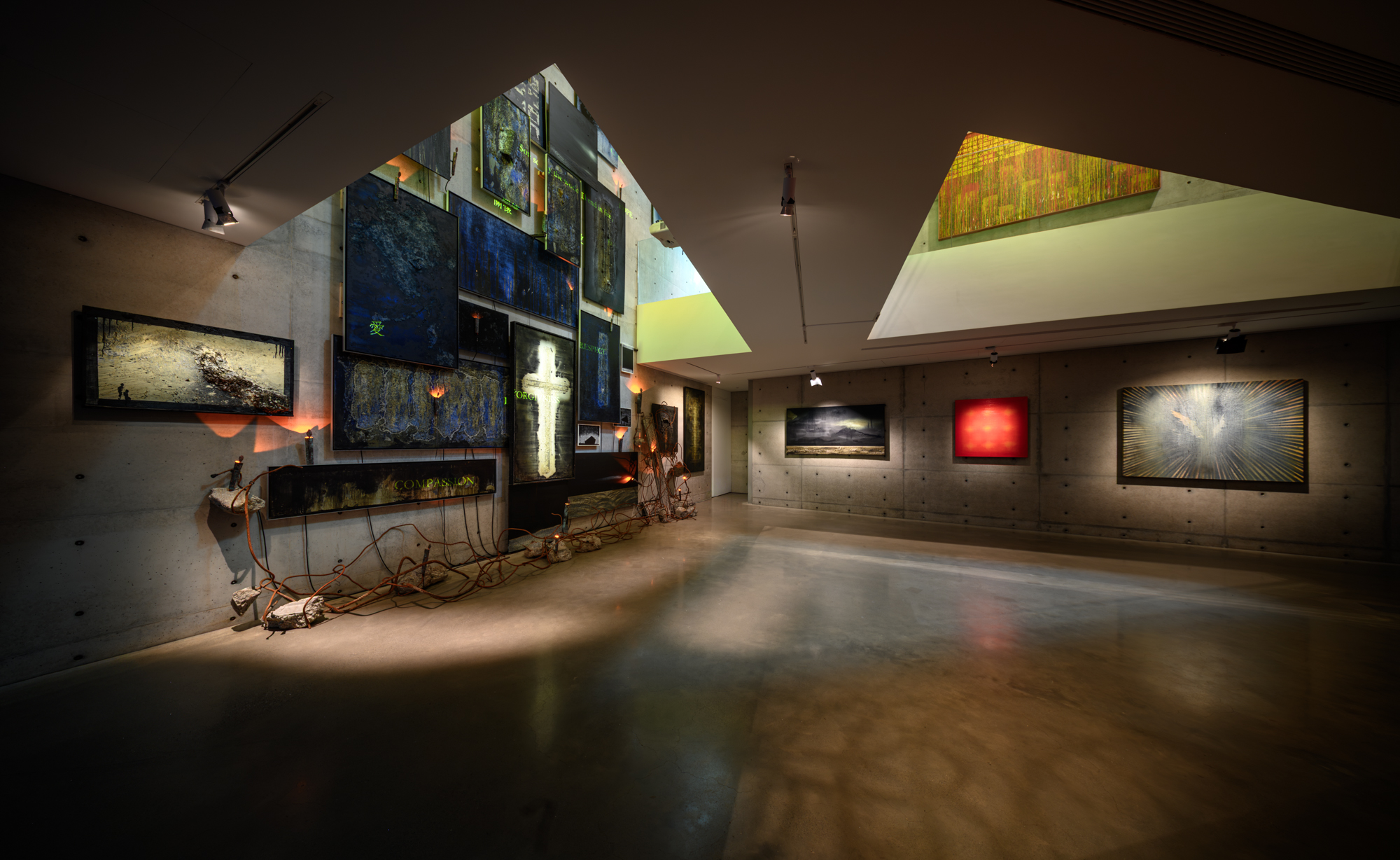
When Russia invaded Ukraine in 2022, Chiang created Perish using discarded construction formwork from the Art Center, hoping that even amid tragedy, a glimmer of light might remain.
Years later, the war continues. Perish is now being shown again in Gallery 3 (Cheng-Han Gallery), a space Chiang regards as a spiritual home, in a newly conceived installation.
The work continues his long practice of responding to suffering through art. From Taiwan’s 1999 earthquake and the September 11 attacks to the pandemic and war, works including Transfigured Night, Meditation on Eternity, and Heart Sutra seek a spiritual way through upheaval, mortality, and impermanence.
Words have long appeared in Chiang’s work. He believes in their extraordinary power throughout human history, offering people stability and solace.
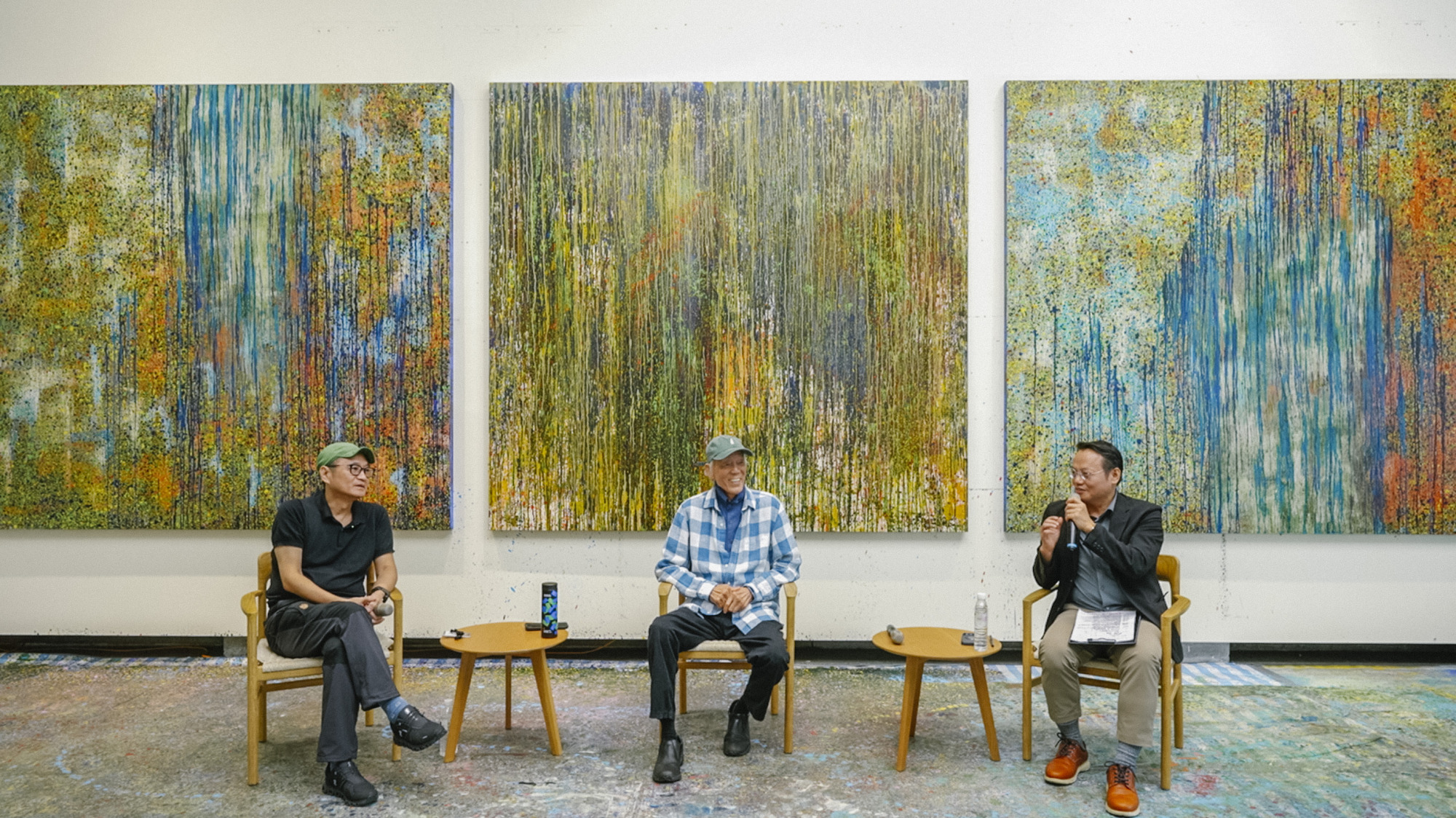
From Breaking Boundaries to Resonance: Art Returns to People
At the exhibition preview, Chiang was joined in conversation by Chia Chi Jason Wang, curator of the 2020 Taipei Fine Arts Museum retrospective Paul Chiang: A Retrospective, and writer Wu Chin Hsun, who has known Chiang for more than a decade and authored his biography.
The 2020 retrospective introduced Chiang’s work to a much wider audience. Some described it as “breaking out of the usual art-world circle,” allowing more people to approach contemporary art.
Wang observed that Chiang’s work in recent years with younger colleagues from the Paul Chiang Arts and Cultural Foundation and The Alliance Cultural Foundation has created another kind of boundary crossing. Their diverse and lively perspectives have entered his daily life, while the exchange between generations has expanded his thinking about what art can become.
Chiang says he now feels “less like an artist and more like an ordinary person.” Where he once pursued perfection, he has become more open to nature, chance, and even flaws.
“What matters more is whether a work resonates with someone.”
“Art can purify the soul” has long been one of Chiang’s core beliefs.
Wang noted with a smile that some people may remain skeptical when they hear such a statement, but Chiang continues to say simply: “This is what I believe.”
Reflecting on Chiang’s serious illness only months earlier, Wu said: “When someone has such a strong sense of hope and such a strong will to live, how could he not also hope for beauty and goodness in human nature?”
Stanley Yen, co-founder of the Paul Chiang Art Center, also spoke at the preview. The Art Center aims to serve as both a local center for aesthetics and a hub for international connection, promoting aesthetic education and music programs that nurture sensitivity to beauty, love, and empathy.
Through international exchanges—including visits by European Union representatives—and the Chiang International Fellowship, the Art Center also invites more creators to Taitung to experience the region’s rich creative energy.
From Chiang’s continuing artistic practice to the Art Center’s growing connections with the wider world, Beyond the Canvas is itself an ongoing process of opening boundaries.
“Life is not always beautiful, but we should still make the most of it. To keep hope for tomorrow is something beautiful—and something very important,” Chiang says.
Beyond the canvas, the world is vast, and life goes on.
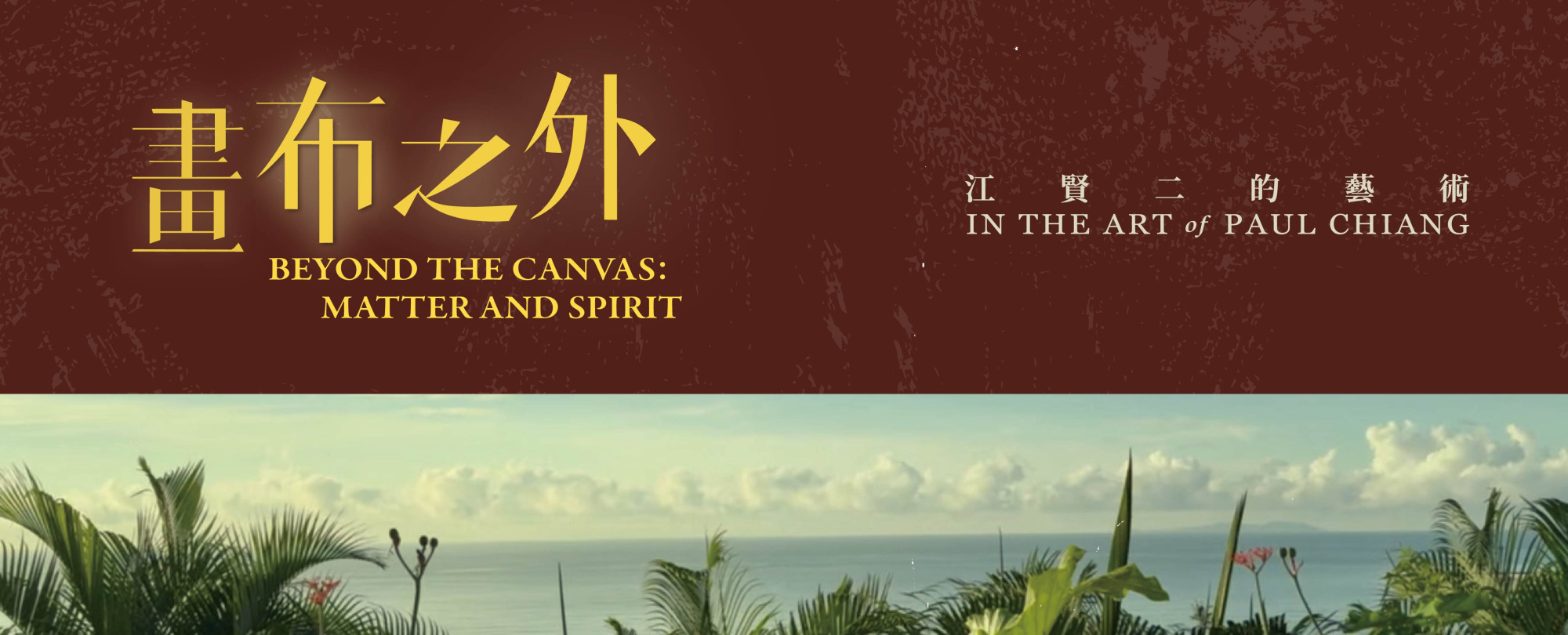
Beyond the Canvas: Matter and Spirit in the Art of Paul Chiang
2026.9.18 — Ongoing
There is currently no set closing date. Like entering the artist’s studio, visitors may encounter changing selections and newly created works over time.