Text | Chin-Hsun Wu
English Translation | Eric Chiang
The Story of an Accident
At the beginning of 2026, Paul Chiang traveled to Portugal to visit his wife, Claire, who was temporarily staying in Lisbon, and his daughter and her family, who live there. During the trip, new ideas and experiments continued to emerge, while several large-scale works he had been conceiving continued to call on him. Chiang therefore decided to leave his wife and return to Taitung ahead of schedule on his own, eager to immerse himself in his work. With his wife—whom he affectionately calls his “girlfriend”—away and no one around to keep him in check, he became increasingly absorbed in the exhilaration of the creation, ignoring the discipline he had maintained for years and continually pushing himself beyond his usual physical limits—until, on the evening of April 22, he fell silently, like a leaf dropping to the forest floor.
Outside, cicadas clamored. Against the floor-to-ceiling windows, the buddha belly plant was entering its brilliant flowering season, waiting in vain for its usual admirer. Hours passed. His assistant found the house dark, dinner untouched, and the door locked from within, phone calls unanswered—the only response was the singing of crickets in the night. After considerable effort, staff finally managed to enter the room. Only after searching through the house did they discover the artist, who had been lying collapsed in the bathroom for some time. He was rushed to the hospital. It was approaching midnight when the surgery had been arranged. As the doctor opened his skull, blood immediately spurted into the air; the pressure inside his brain had reached a critical level. Had they arrived any later, the consequences could have been devastating.
In early May, Chiang was discharged from the hospital and returned home. At first, he could do little more than remain confined to his bed to recover, his spirits low and his mind filled with doubt about whether he would ever be able to stand up and return to his work again. He restrained his impatience and followed his rehabilitation regimen each day. Fortunately, his strength gradually returned. Later, he wrote to a friend: “This accident has made me realize how fragile life could be. Especially as we grow older, we cannot push ourselves too hard, whether at work or in everyday life.”
Having had a brush with death and survived by extraordinary good fortune, Chiang spent his days in bed gazing through the windows at scenery he had never truly taken the time to appreciate. To his surprise, he began to discover in it an entirely new fascination. Moved by what he saw, he could not resist recording the scenes one by one on his phone. At the same time, the central idea for his September exhibition began to take shape.
Beyond the Canvas
Ever since the completion of the Art Center, Chiang has repeatedly asked himself: “After sixty years of creating on canvas, beyond it what possibilities for art are there?” In the end, he chose Beyond the Canvas as the central theme of this new exhibition. The canvas has not been discarded; it remains his spiritual point of origin. Yet art has spilled outward—into the body, the land, nature, architecture, and the boundless living experiences—pointing toward an existence, alive and still coming into being.
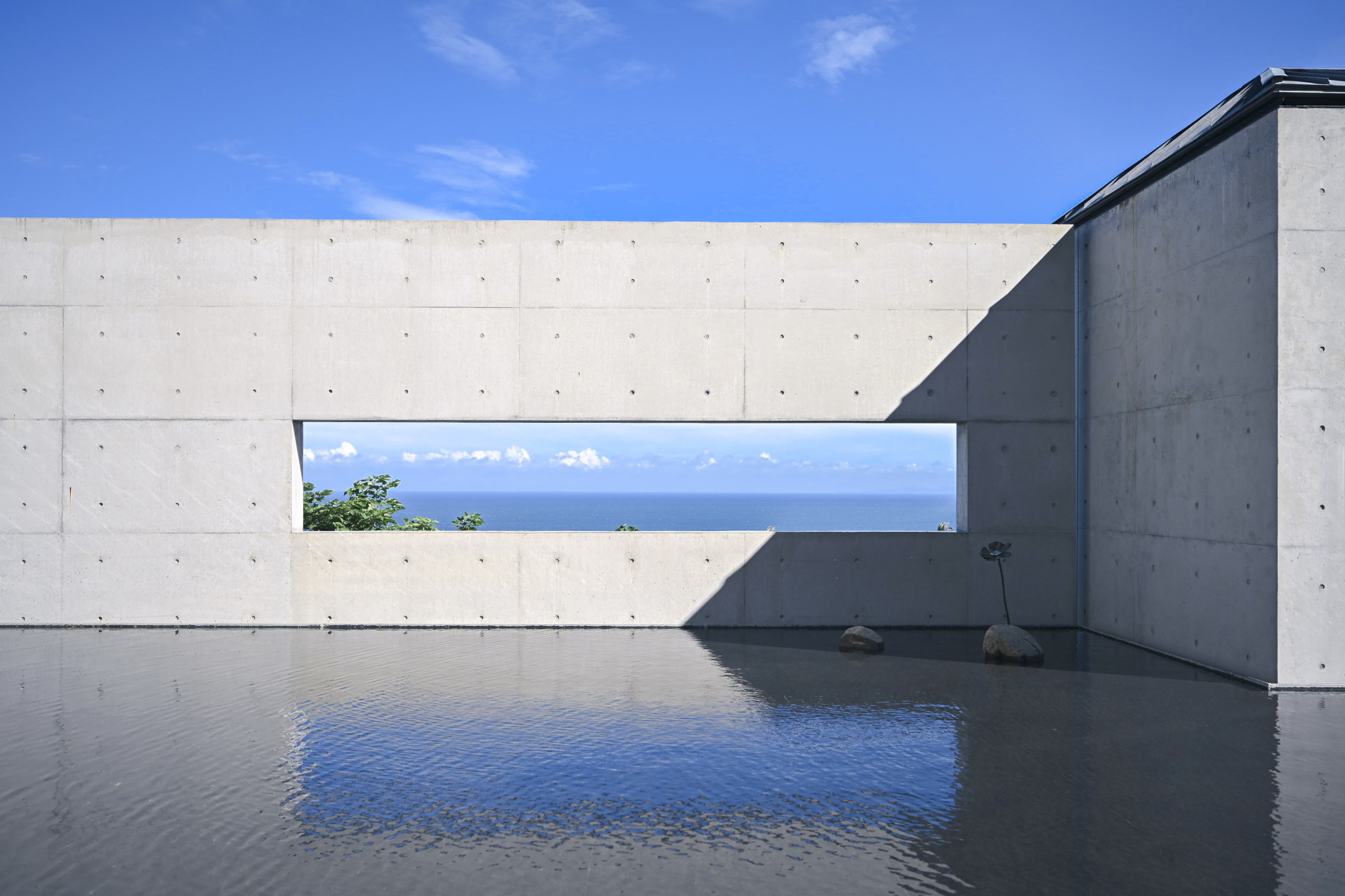
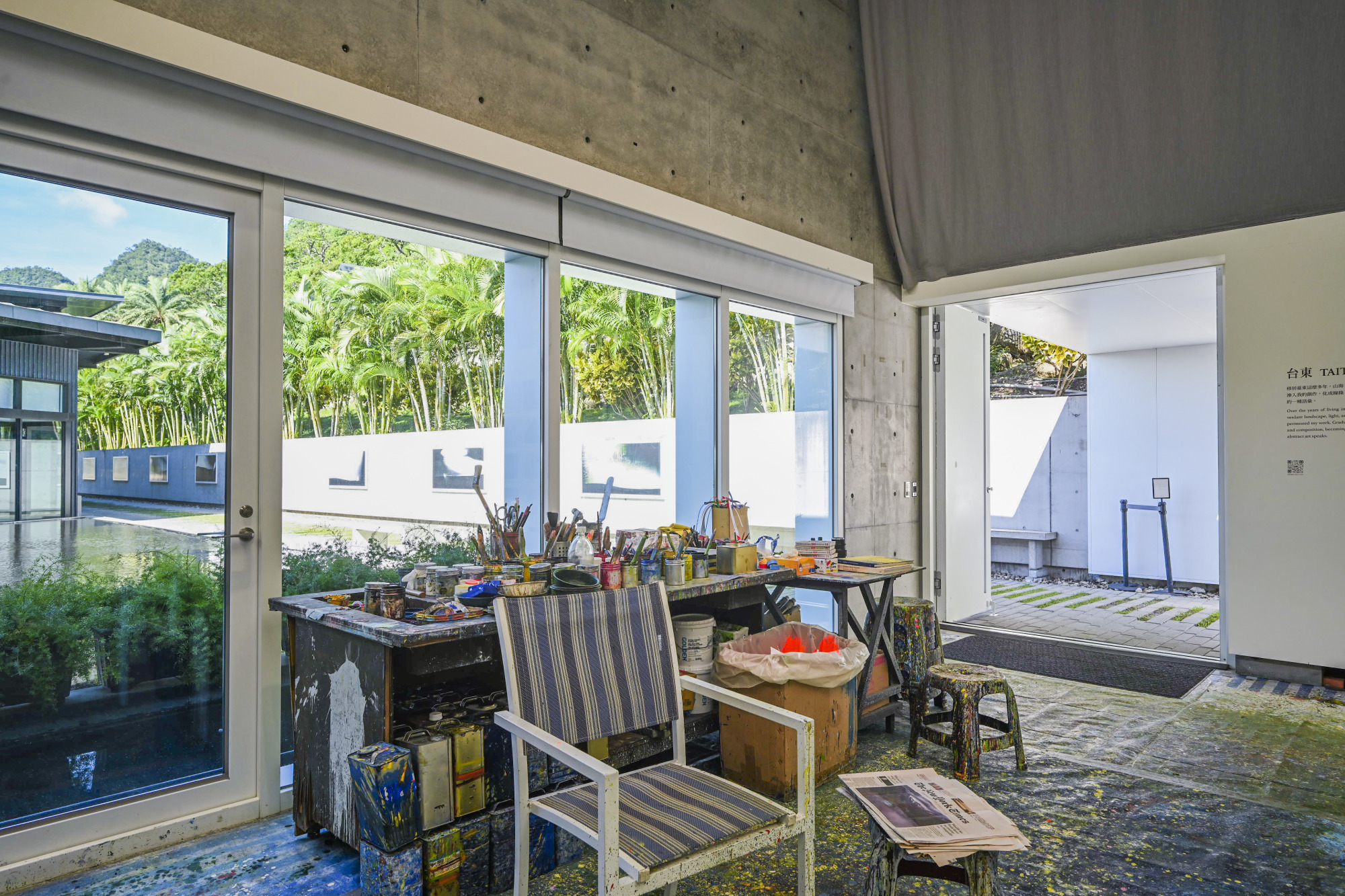
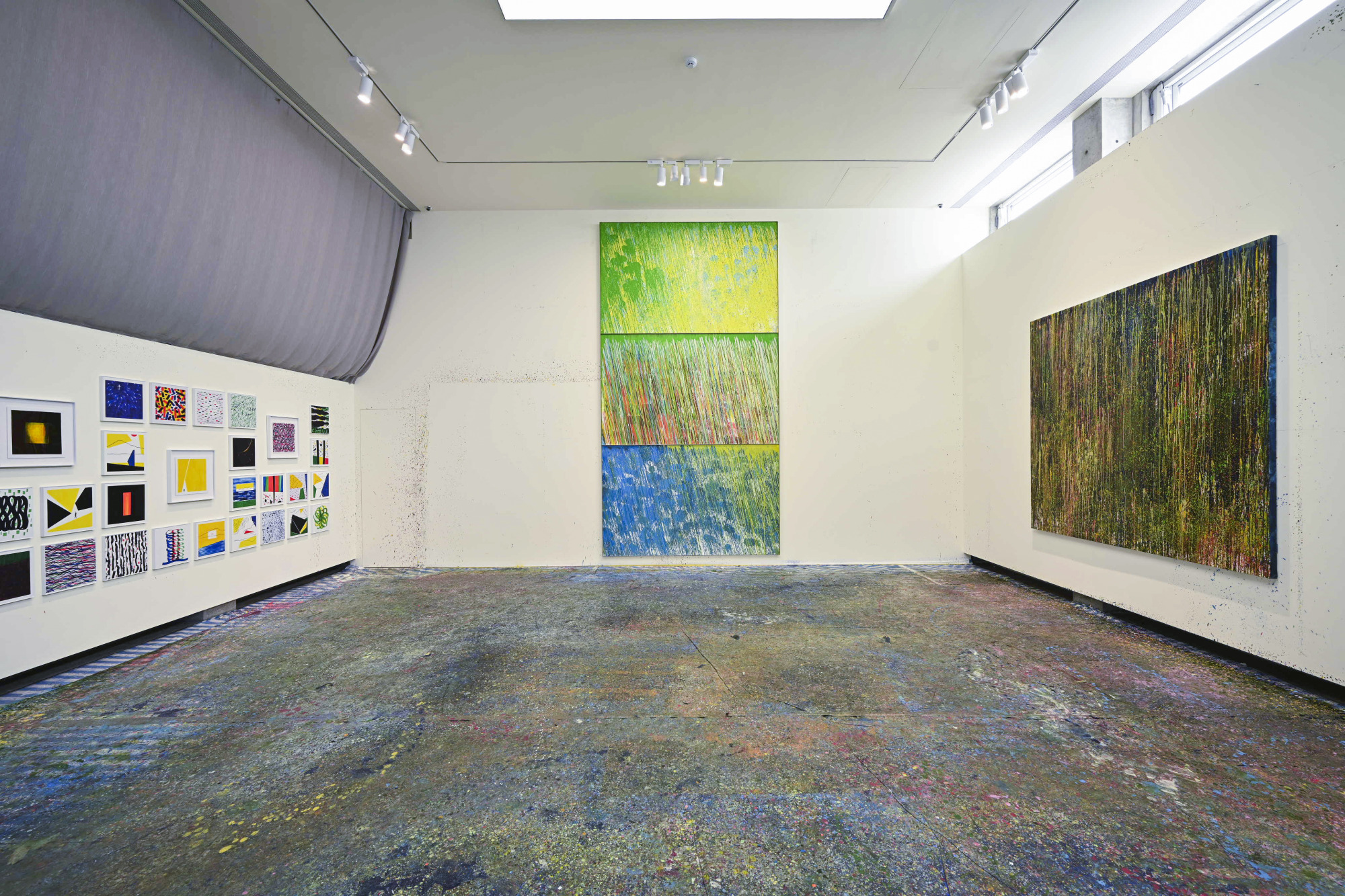
The exhibition’s central theme, Beyond the Canvas, extends, as its subtitle Matter and Spirit implies, into a broader dialogue between the material and the spiritual. Entering the Gallery 1, at the far end of the Serenity Pond, visitors immediately step onto the blue-and-white striped canvas floor coverings, as though entering an artist’s studio. The fabric is stained with splashes and mottled fragments of color, suggesting that Chiang had been working there only moments before and had just stepped away for a break. On a table by the window lie brushes, paint containers, piles of sketches, and yellowing copies of The New York Times. At certain moments of the day, sunlight strikes the Serenity Pond at just the right angle, sending rippling patterns of light dancing across the ceiling and the walls. Immersed in this quiet ambience, one would sense intimacy with an idea taking form.
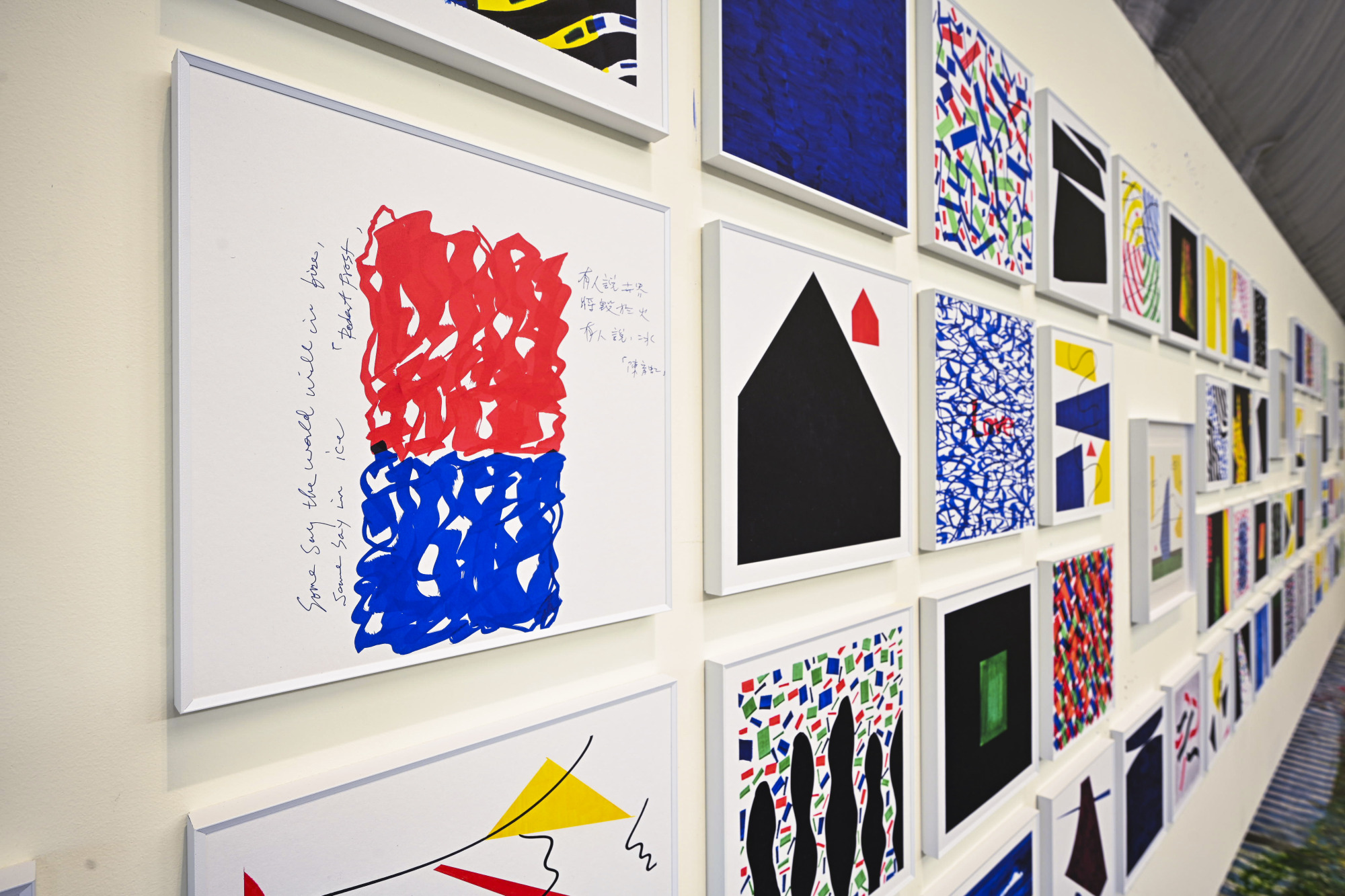
Beneath the skylight, an entire wall is filled with works from the Jazz-Jinzun series, revealing Chiang’s explorations of line, color, and composition. More than sixty works of similar sizes take turns like jazz improvisations—brisk, spontaneous, and each with a rhythm of its own. Three or four years ago, as construction of the Art Center moved into full swing, the available space for creating large-scale works became increasingly limited. To satisfy the creative impulse that could ignite at any moment, Chiang gradually developed a more portable and practical way of working with markers. It took him only a short time to move from tentative experiments to fluency, after which he entered an intensely productive period, eventually creating nearly five or six hundred works.
This pursuit, which began with an interest in lines and geometric forms, has recently expanded toward works on a larger scale.
The newly created Circle of Life 26-25 carries the feel of the transition from spring into summer. Yellow and green mingle across the upper section of the canvas like new leaves unfurling in the sunlight. In the middle section, dense vertical lines evoke blades of grass, bamboo groves, and pouring rain; colors flowing downward under the force of gravity. Deep blue surges from below, recalling the sea off the Taitung coast on a summer afternoon, or the transient darkening of earth and sky as a storm approaches. Standing before the work, the viewer is met by a field of fine diagonal lines, recalling “Threads of Rain” by the Taiwanese poet Zheng Chouyu (鄭愁予), in which rain “slants and slants, weaving pale memories.” Joy, love, loss, and memories are all scattered across a field of luminous colors.
Chiang’s art has always evolved as a function of the spaces he inhabits and the life he experiences. After moving to Taitung, the surrounding sea, mountains, trees, light, and changing seasons gradually seeped into his work. “I’ve lived in the same place for nearly twenty years, and every day I see either the sea, the mountains, or trees. What is most distinctive is that trees expose so many lines, together with their flowing leaves. Over the past two years, many straight lines have appeared in my work, and they have quietly become an important vocabulary in my abstract art.”
Extending this sense, three selected panels from Jinzun-Autumn 26 are filled with even more falling lines, transforming autumn from a season of decline into a magnificent blaze of life. Golden yellow, russet red, emerald green, and darker blue overlap in layers. Tiny specks between the lines resemble seeds, pollen, and stardust, seemingly falling down while at the same time growing upward. Amid the dense interplay of movements, there remains a profound and lingering silence.
Light and Hope
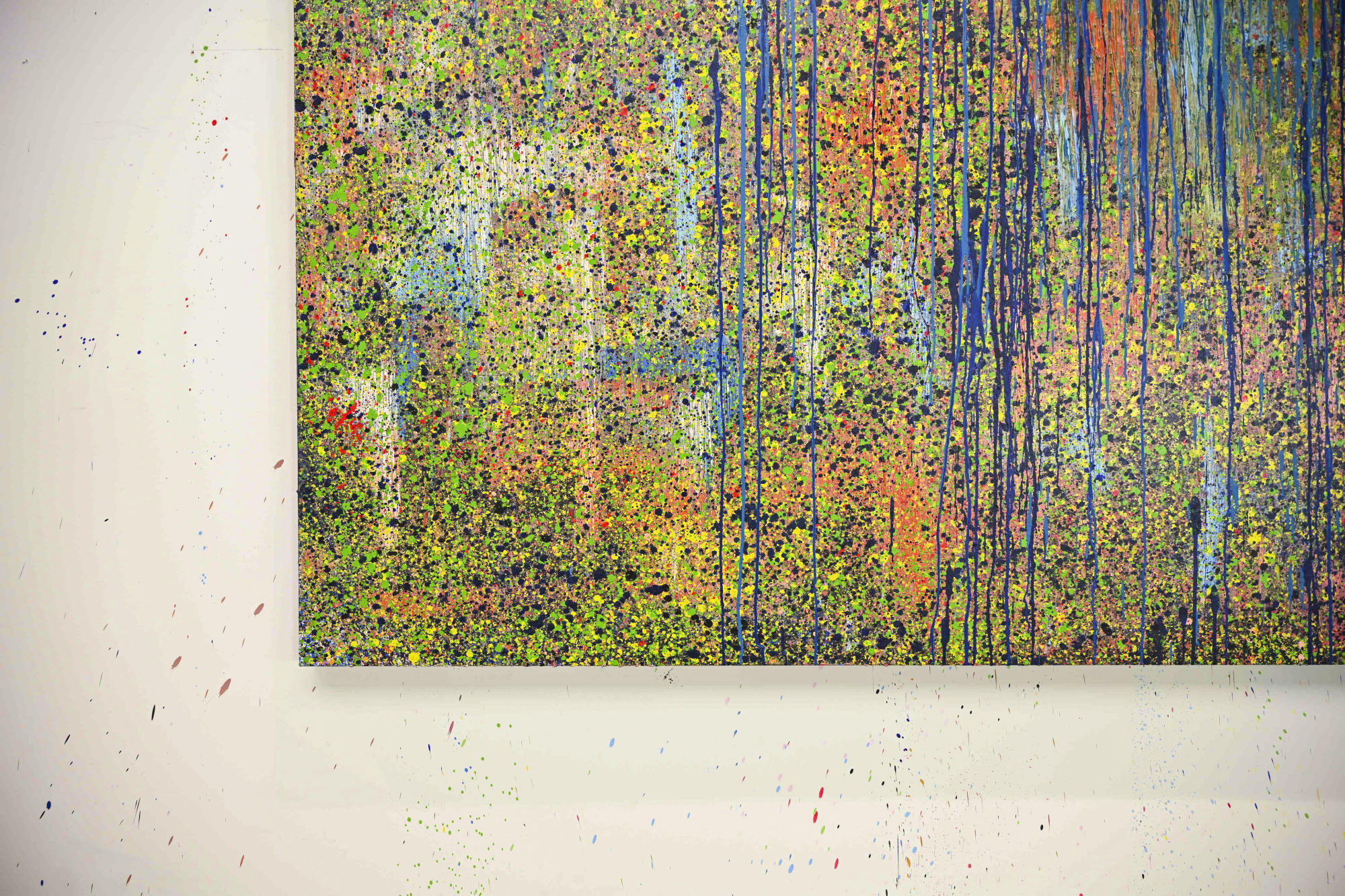
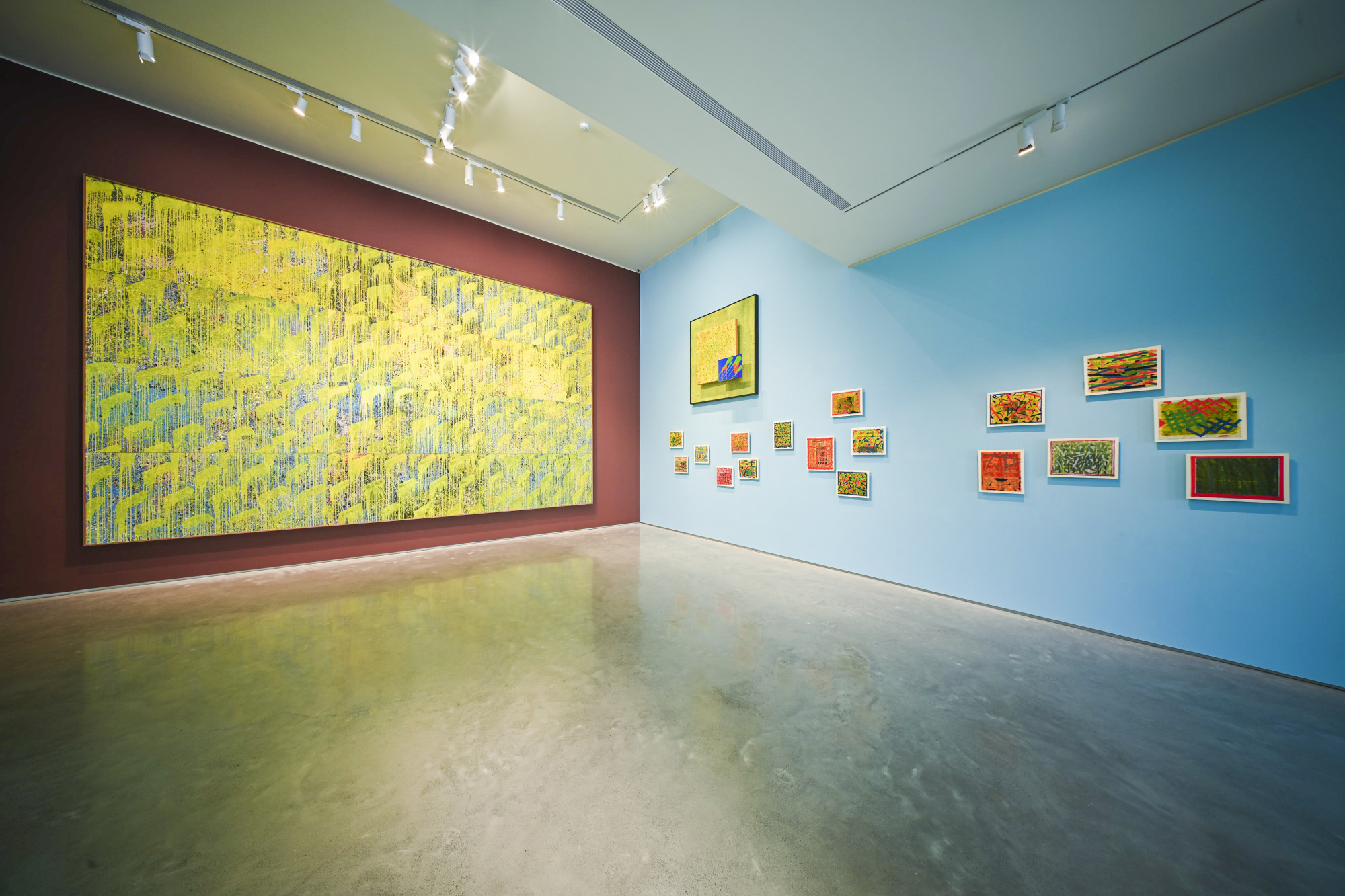
On the main wall of Gallery 2-1, Chiang’s new work Circle of Life 26 unfolds across twelve joined panels into an expansive field of blue, green, and yellow colors. Thick, densely applied yellow paint drips vertically following the gravity. Seen up close, certain passages conceal diagonal lines; others are filled with scattered splashes or pigments rubbed and gathered into masses. Within an imposed order, undercurrents still surge, gradually erasing boundaries, directions, and centers—as though life itself were struggling to find a new breath amid disintegration, following the light in search of hope.
The square work Circle of Life 25-61 was completed before Chiang’s accident. The artist layered a second and third work onto the first, allowing color, light, shadow, and space to enter into new relationships. The flat and the three-dimensional, subtle light and shadow, and vivid color collide with one another. The viewer’s gaze moves between near and far, inside and outside, light and dark. Light gradually ceases to be merely an image within the painting and becomes instead a force that traverses the layers and transforms the space.
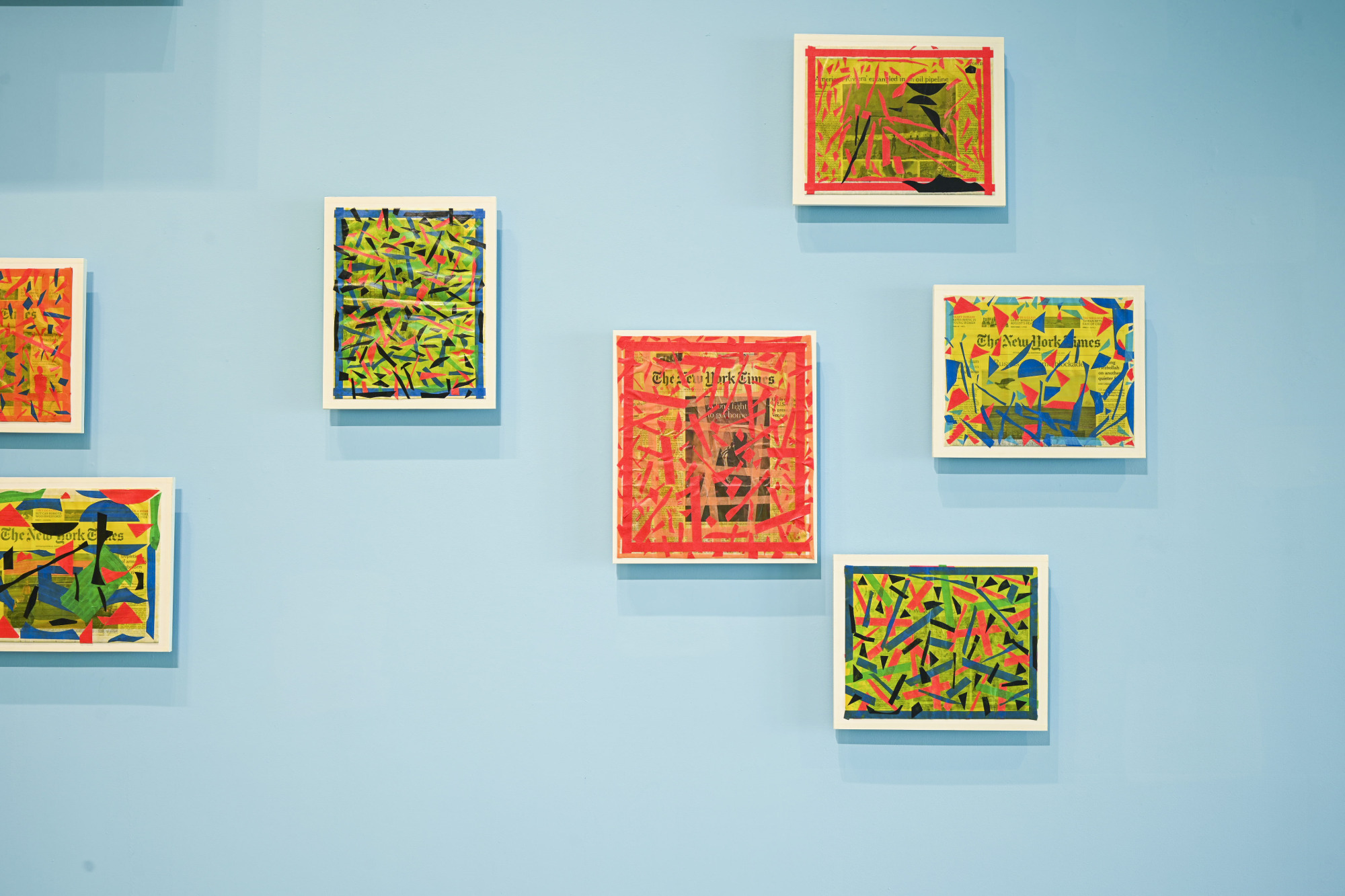
For six decades, Chiang has read The New York Times every day, gradually accumulating a large collection of old newspapers. Morning Reading—The New York Times, a mixed-media collage based on these newspapers, is a new way of creating that Chiang developed in response to the limitations of his body and age.
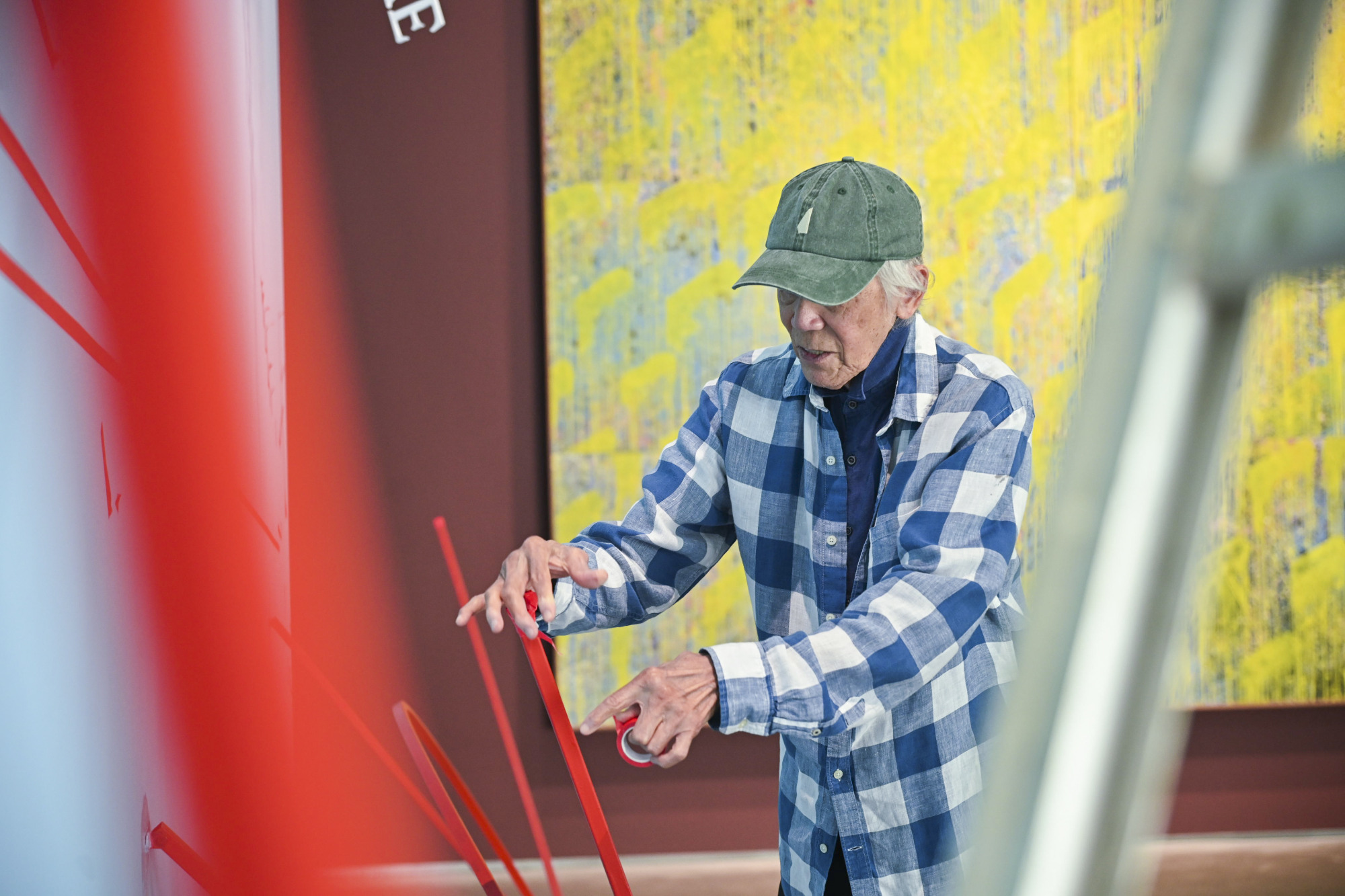
Over more than a century, the newspaper has developed a rigorous visual system—from its masthead, columns, and headline sizes to the dimensions of photographs—carefully guiding the reader’s gaze through the page. Chiang cuts and reshapes colored tape and applies oil paint to create a “second edit” over the original layout. The tape functions both as a “cut” and a “seam”: layered across passages concerning culture and the arts as well as social issues, it intervenes in the order of the printed page through abstraction, creating subtle resonances with the content beneath.
From a distance, viewers first encounter an abstract rhythm formed by interwoven reds, blues, greens, and blacks. As they move closer, figures, headlines, and events begin to emerge from beneath the colored bands. Just as one is about to read, the tape interrupts the gaze; stepping back to view the work as a whole, the words intrude once again into the composition. The eye repeatedly moves through a process of “reading—interruption—jump cut—reassembly,” creating a mode of looking akin to the syncopated rhythms of jazz and extending the spirit of improvisation found in the Jazz-Jinzun series. The lively energy that animates the work is also a new revelation after the page of pain has been turned.
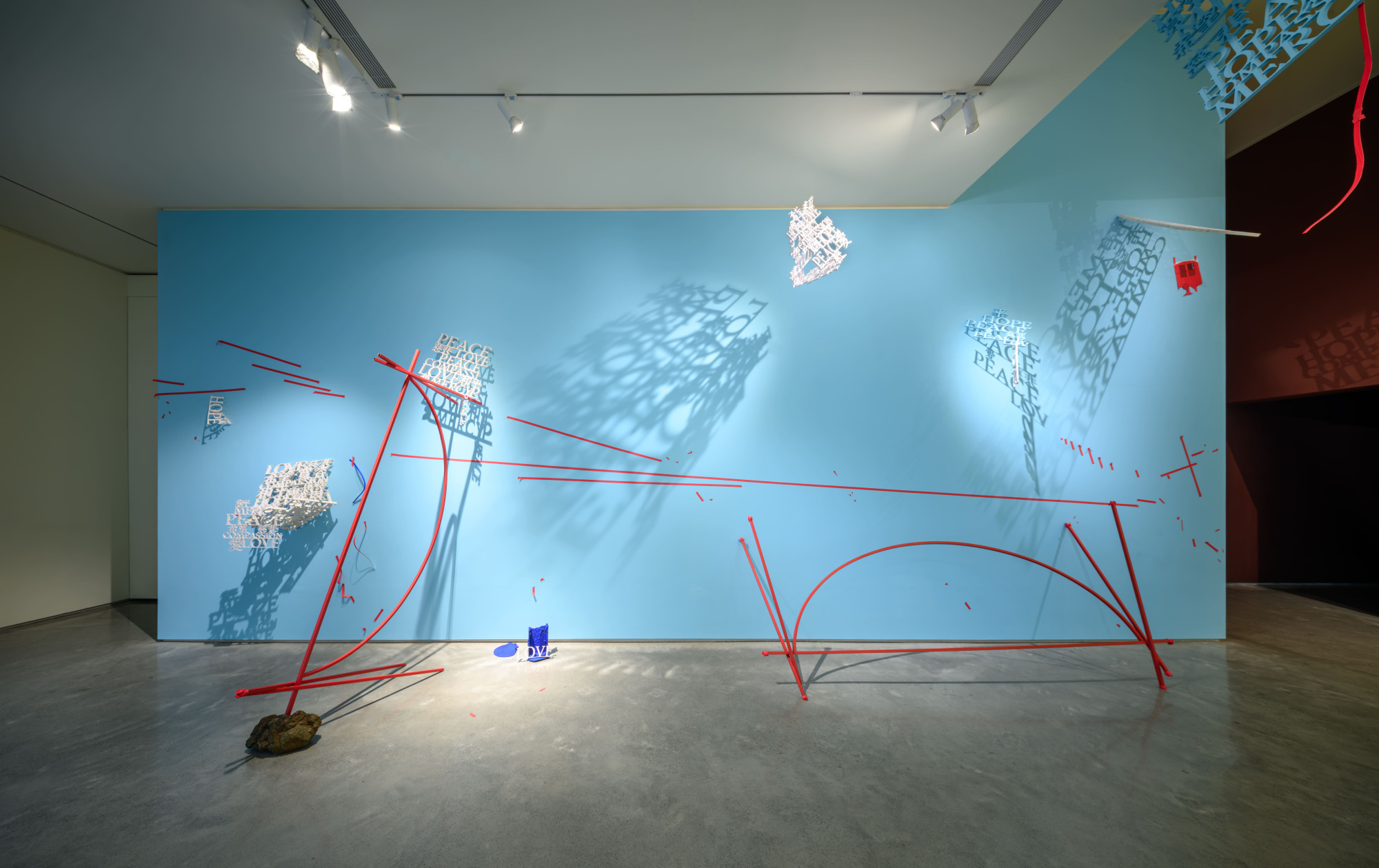
For Beyond the Canvas 26, Chiang worked in situ before a nine-meter-wide wall, transforming the entire pale-blue surface into a work that is still becoming. Words such as LOVE and HOPE jump off the pages and the sentences behind, suspended in midair against the wall. Light passes through the letters and casts displaced shadows onto the wall, giving each word both a physical presence and an echo. Strips of red tape extend in parallel, then turn and break, pulling against the exposed red steel lines before them.
Chiang sees this work as an extension of an earlier work Jinzun-Poetic in 2020: painting leaves the canvas and integrates with space, light and shadow, and direct sensory experiences. Yet compared with his concerns at the time over the durability of the materials and the degree of finish, Beyond the Canvas 26 is closer to something unembellished. The tape may peel away, while the steel rods give away the traces of temporary installation and hand-tied construction. Refined technique is no longer the artist’s sole pursuit. At this point, Chiang places greater value on truthfulness and freedom of emotion.
The Blank Spaces of Life
If Gallery 2-1, with its gilded brilliance and luxuriant profusion of colors, represents a process of addition, then passing through a narrow corridor into the inner gallery leads the viewer into a world of subtraction.
In the stage area near the entrance, new works from the Songs without Words series are on view. An almost boundless ultramarine occupies the surface. Layer upon layer of oil paint expands, becoming a deep night, the ocean, and the slow descent of consciousness into a realm of silence. The blue appears quiet, yet its surface is filled with scratches, seepage, and shifting depths of color. In one work, dense black layers press down upon the blue, while several red circles appear at different points across the painting, like the coordinates, wounds, or signals sent from distant galaxies across the darkness.
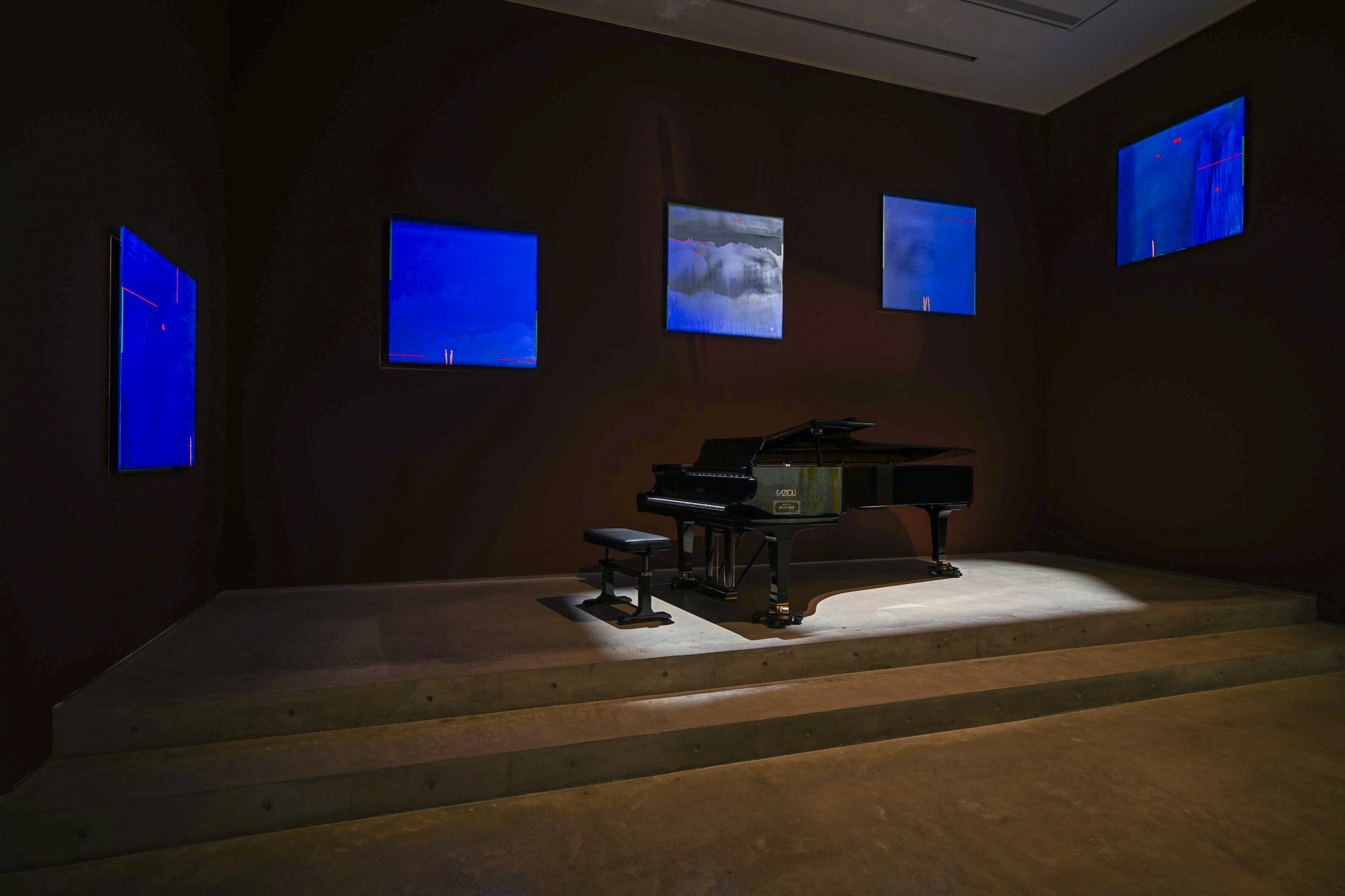
In four of the works, orange-red forms at the bottom resemble both candles and human figures standing together. Tiny white flames are almost swallowed by the vastness surrounding them, bearing the weight of the deep blue while continuing to affirm the persistence of the human spirit through their small flames. The group of works continues the geometric vocabulary of the Songs without Words series, simplifying its forms until nothing but lines and circles remain. The red lines echo the site-specific work Beyond the Canvas 26 on the wall, while the candle imagery below resonates with the bronze candles in Art Can Purify the Soul 26-02. Painting, site-specific work, and installation thus draw one another to form a silent and continuous spiritual thread throughout the exhibition.
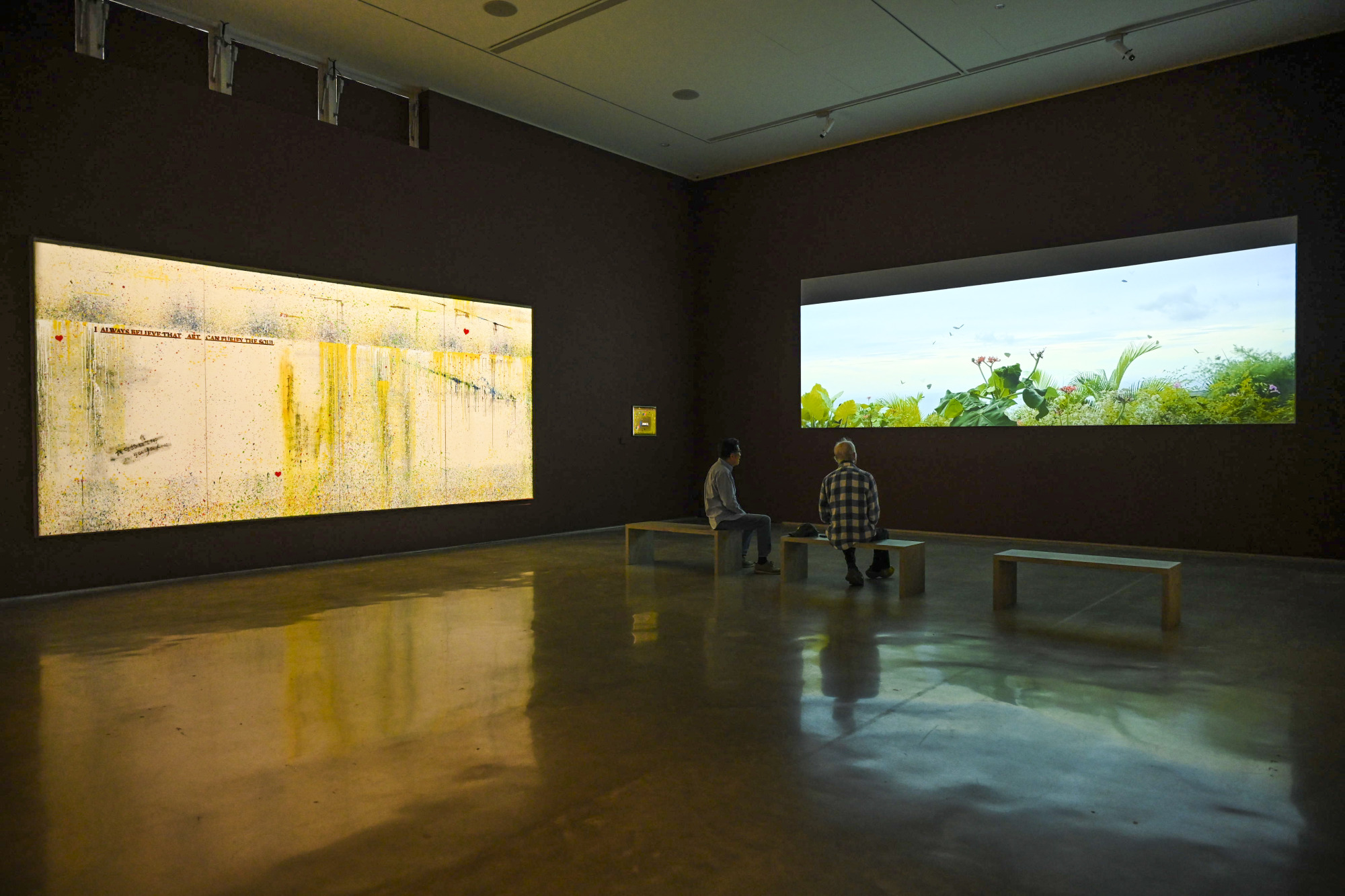
Further inside, the new works occupying the other three large walls were all created after Chiang’s accident. On the east wall, the physical support of Art Can Purify the Soul 26-01 was originally a section cut out directly from a wall of Chiang’s studio, like a negative film before the positive image or rather, the far side of the moon. Countless works had been completed before this wall, leaving behind inevitable traces of splashed paint, wiping, color tests, and other unintended marks. Chiang had never looked closely at it before. After his accident, however, he came to see this “blank wall” entirely differently. “What moves me most about it,” he says, “is how natural it is, without any pretense. For the first time, I realized that all these little marks on the wall are incredibly beautiful!”
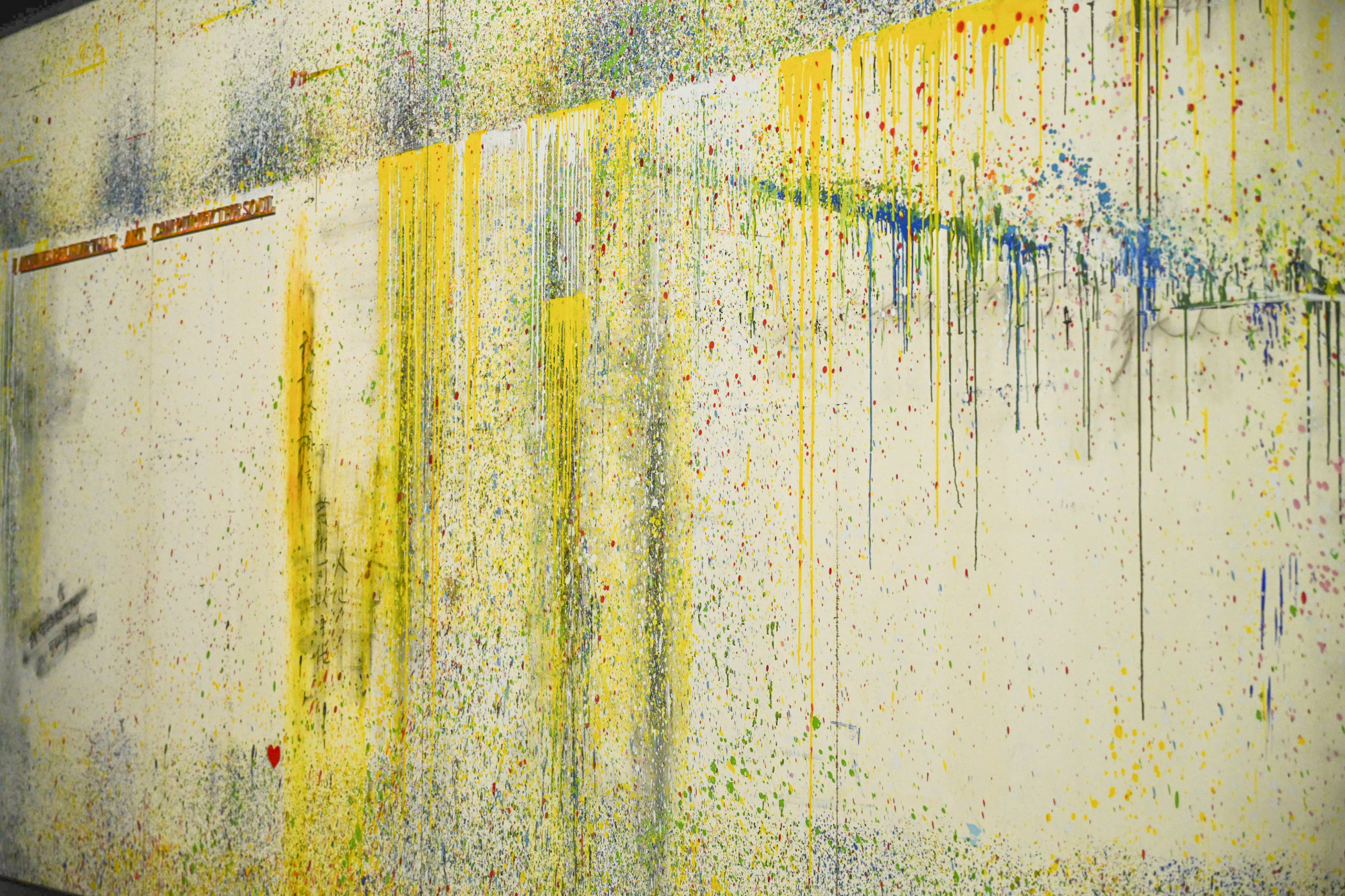
Broken black lines and bands of blue and green cross the wall, while a broad expanse of blankness at the center allows the surrounding clamor to settle. There is no display of technique here, nor was the wall originally conceived as an artwork. For that very reason, it is closer to a landscape slowly formed by time. The artist allows the wall, chance, and time themselves to take their place within the work. Across its surface, he writes by hand: “I always believe that art can purify the soul.” The words appear weathered and worn, like an aphorism carried across sixty years.
On the opposite wall, in Art Can Purify the Soul 26-02, pigments of different colors descend following the gravity, while splattered dots preserve the accidental, unembellished tremors of life. Within a recessed channel at the center, a row of candles stands like silent human figures, turning the entire wall into a wordless ritual. Peace, too, seems to resemble this small point of light: one must draw near and look closely to see it.
The final work in the gallery, Window, is Chiang’s first experiment with moving-image art. The accident forced him to spend long periods contemplating the framed view before him. The window separated him from the world, yet it also allowed the world to enter his life anew. Things he had once overlooked—the buddha belly plant, morning glory, yellow palm, elephant ear—now entered his field of vision one after another, bringing with them a renewed sense of seasons, time, and poetry. Dawn and dusk, the morning star, violent wind and rain, the singing of insects and cicadas, butterflies filling the sky—through them he felt the expansive, generous, and deeply tender touch of the natural world. This is Chiang’s “most realistic” work, witnessing that he is alive. It carries his heartfelt gratitude to his wife Claire, who has accompanied him throughout their life together.
Many nights, alone, he watched the wind bend the leaves flat to the ground, only to see them stand up again after the rain. The fragility and resilience of life played out repeatedly before his window. From his sickbed, the artist looked at the same scenes. At times, time itself felt heavy as lead; then a beam of light, a flower, or a butterfly would suddenly make it light and transparent. The American poet Emily Dickinson writes in “After great pain, a formal feeling comes -”:
“After great pain, a formal feeling comes -
... This is the Hour of Lead -
... First - Chill - then Stupor - then the letting go -” (excerpt)
After immense pain comes a feeling of solidity and solemnity. This is “the Hour of Lead”: first chill, then numbness, and finally, letting go. What is it that one lets go of? The poet does not say. The lines seem to echo Chiang’s state of mind after his accident. He has repeatedly remarked that he now feels more at ease, more relaxed, and more accepting of certain incompleteness. “I am gradually learning to appreciate blank spaces, flaws, and mistakes. They are, in fact, all very beautiful.”
A Compassionate Prayer
Chiang’s understanding of blankness and letting go extends into Gallery 3. On the first floor, the Perish series forms the spiritual axis: burning and freezing, passion and stillness, together with the Transfigured Night series, follow a passage from conflict toward tranquility. Near the entrance, the red, ten-panel work Meditation on Eternity 02, with its warm tones and halos of light appearing as dots and lines, brings a sense of consolation, soothing the fissures left by conflicts and gradually turning toward a meditation on the possibility of purification.
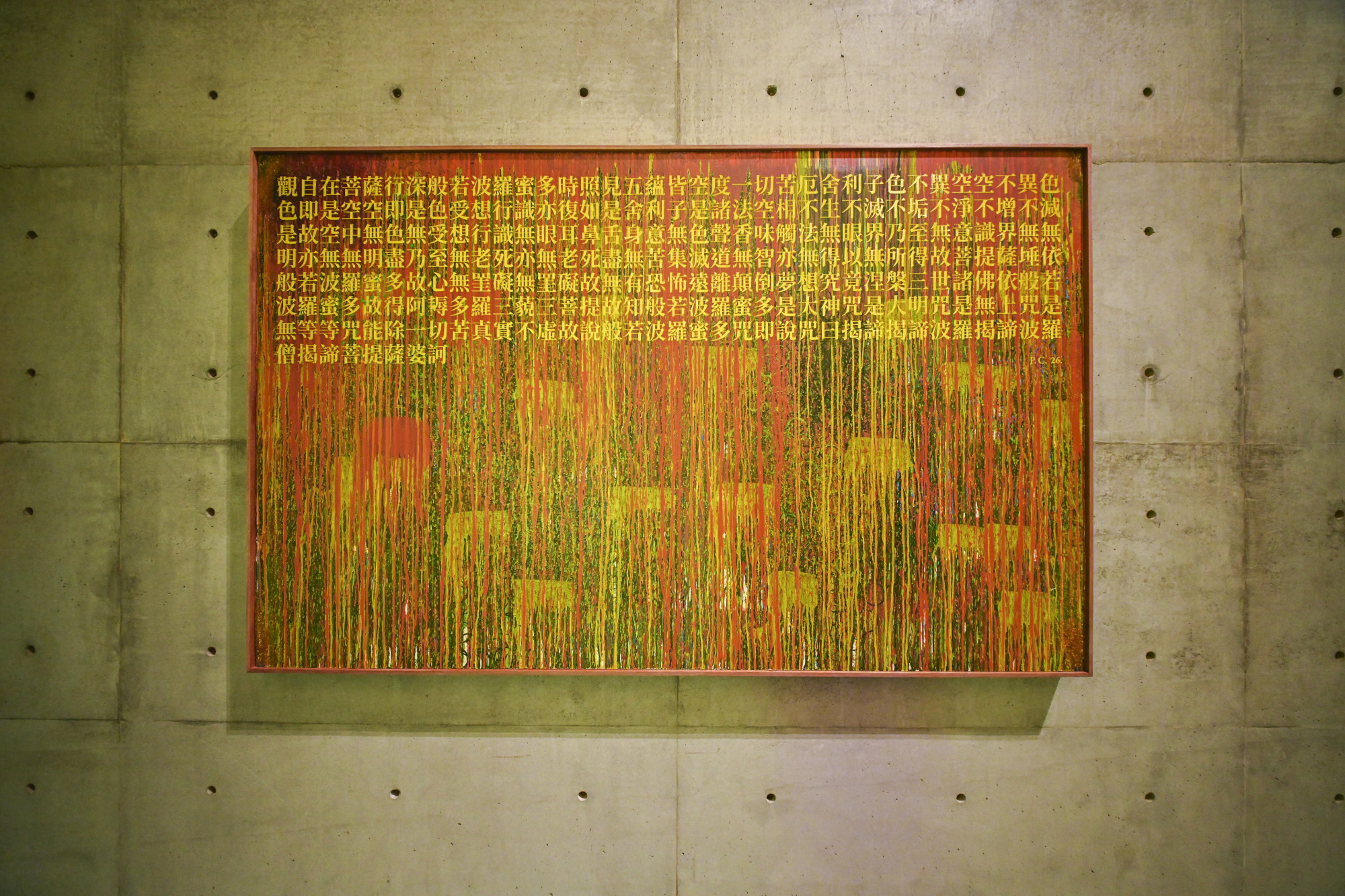
As viewers ascend the stairs to the second floor, the movement of the body imperceptibly becomes a spiritual transition for them. On the main wall are two works from The Heart Sutra series, neatly inscribed with the words: “Avalokitesvara Bodhisattva, while contemplating deeply the prajnaparamita, realized the five aggregates are empty and was liberated from all suffering and hardship…”
In only 260 Chinese words, the Heart Sutra offers a distilled expression of the Buddhist understanding of dependent origination and emptiness: all things arising through causes and conditions possess no independent, unchanging existence. Impermanence, non-self, and interdependence. Standing before the paintings, viewers may experience the sutra as a small vessel of Dharma, moving slowly through a dreamlike world of dripping pigments and seemingly lush, dazzling illusions. As the mind follows the words, the gaze grows still, gradually giving rise to a feeling of clarity and solemnity.
The Resonance of Beauty and Goodness
As early as the 1970s, during his years of quiet perseverance in New York, Chiang held fast to the belief: “I always believe that art can purify the soul.” After sixty years of tireless practice and cultivation, at the age of eighty-four he has arrived at an even clearer realization:
I understand more and more clearly that all my art—whether two-dimensional, three-dimensional, moving image, or spatial—ultimately points in one direction: toward the beauty and goodness of human nature. I hope that through my work, viewers can quiet themselves, reconsider their own lives, and at the same time feel a sense of hope—that tomorrow can be better than today.
When Chiang rose to his feet again after his accident, the vitality he displayed was deeply inspiring. His powerful drive to create proved to be the finest medicine for rehabilitation. Beyond the canvas, the world is vast, and life goes on.
As dusk comes closer, the buddha belly plant outside the small house stands in bloom with red flowers, its green seed capsules already formed while another cluster of buds still waits to open. The yellow palm’s slender, feather-like fronds overlap in layers, forming rhythms in the sea breeze. Morning glory vines climb along the railings, while elephant ear spreads its glossy, umbrella-like leaves, catching the final trace of daylight. It is as though, simply because someone is watching, they have become more beautiful.
—The sea in the distance bears witness to its own eternity through the boundless remoteness; the flowers, blooming only for an instant, offer their silent replies.